

One of the very first things I do when I want to clean up my nutrition, regardless of whether I’m working towards performance or fat loss goals, is take inventory of my alcohol consumption. Alcohol is one of those things where it’s easy to feel like you’re keeping yourself in check, but in reality, could be secretly throwing off your macros and hindering your progress.
While you may only be having a drink or two on any given day, multiple drinks across a week can really add up (especially if you’re not accounting for your drinks).
Before I get into my suggestions for managing alcohol consumption while working toward your goals, let’s discuss the preferred method for tracking alcohol as part of your overall macros.
The calories in pure alcohol are not classified as protein, carbs, or fats. This means that you can’t log a drink accurately by just scanning the barcode; however, it does mean that you get to decide how you want to account for your drink. You can choose whether you want to track it as carbs, fats or a mix of the two.
EXAMPLE: A 5oz glass of red wine is 129 calories in MFP (0P/0F/4C). If you log this red wine as is, you are only accounting for 4 grams of carbohydrates, or about 16 calories. This leaves you with 113 calories that are not accounted for, but have been consumed.
In order to track more accurately, the best practice is to track alcohol as either carbs, fat, or a combination of the two. Doing this rather than just inputting the existing listings in MFP will allow you to still hit your macro targets perfectly.
If tracking using carbohydrates: 129 calories divided by 4 cal/g = 32g carbs
If tracking using fat: 129 calories divided by 9 cal/g = 14g fat
If tracking using a combination:
64.5 calories divided by 4 cal/g = 16g carbs
AND
64.5 calories divided by 9 cal/g = 7g fat
This easy-to-use Macro Alcohol Calculator will help you figure out the number of calories and macros in your favorite drinks, and help you to convert them into carbs, fat, or even a combination of both.
Is it Better to Track Alcohol Macros as Carbs, Fats, or a Combo of Carbs and Fats?
So… which option is better? Well, that’s going to depend on your macros for the day and which option fits into your day best. It’s important to note, which route you decide to take each time may change too depending on what else you have already consumed/plan to consume that given day.
My best recommendation would be to look at your day as a whole. Is your day more carb heavy? Is your day more fat heavy? For example, if you have been traveling and eating out a lot, you’ve likely been consuming higher fats because restaurants use a lot of oil. So in that case, I would recommend allocating more of those alcohol calories towards carbs. But if it’s just a normal day at home and you want to have a margarita, you may have more balanced macros, so you may decide to allot half to carbs and the other half to fats.
Ok, so you just need to know the calories in order to track alcohol macros… COOL. But…
What if I Don’t Know How Many Calories Are in My Drink?
If you can’t find the exact calories for your drink of choice, don’t worry! Generally, similar types of drinks will have similar calories and if you only drink on occasion, it really doesn’t matter in the grand scheme of things! I will typically do a quick google search, find something similar and call it good!
Truly it’s not worth overthinking, just go with what makes sense and don’t stress it.
BOOKMARK this easy-to-use Macro Alcohol Calculator that will help you figure out the number of calories and macros in your favorite drinks, and help you to convert them into carbs, fat, or even a combination of both.
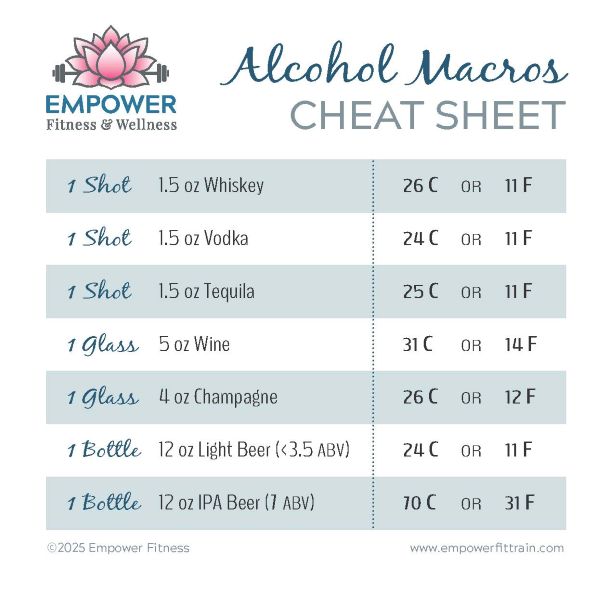
Alcohol Macros Cheat Sheet
| 1 Shot 1.5 oz Whiskey | 26 C or 11 F |
| 1 Shot 1.5 oz Vodka | 24 C or 11 F |
| 1 Shot 1.5 oz Tequila | 25 C or 11 F |
| 1 Glass 5 oz Wine | 31 C or 14 F |
| 1 Glass 4 oz Champagne | 26 C or 12 F |
| 1 Bottle 12 oz Light Beer (<3.5 ABV) | 24 C or 11 F |
| 1 Bottle or IPA Beer (7 ABV) | 70 C or 31 F |
Alcohol is just one of the variables that macro tracking has to account for in real life and it’s rarely the only one. If you’re finding that real-life situations keep knocking you off track, book a free connection call and let’s build a flexible approach that actually holds up.
 Out of a Macro? 5 Proven Tips to Hit Your Macros by End of Day
