

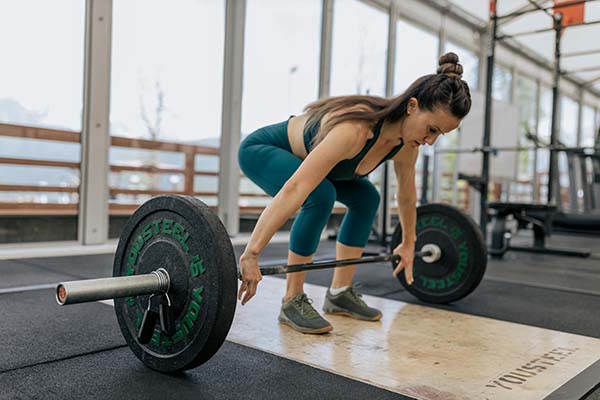
Rep ranges for women are guidelines, not rules you have to follow perfectly every single workout. If your program says 3 sets of 10 and you hit 8, 10, and 11, you did not fail. You trained exactly the way you were supposed to.
This is one of the most common sources of stress I see in women who are new to strength training and even in women who have been lifting for years.
They miss their rep target by one or two and spend the rest of the workout feeling like they did something wrong. They did not. And understanding why can completely change how you approach every session.
What Are Rep Ranges and Why Do They Matter for Women?
Rep ranges for women are the prescribed number of repetitions you should aim to complete in a given set. They are built into your program to create a specific training stimulus, whether that is building strength, increasing muscle size or improving muscular endurance.
For women specifically, rep ranges for women that fall between 6 and 15 reps are typically the sweet spot for building and preserving muscle. Lower rep ranges build maximal strength, while higher ranges improve endurance. The range your program uses depends on the goal.
What rep ranges are not is a rigid target that must be hit exactly every time you train. They are a window and landing anywhere inside or close to that window, while training with real effort, is exactly what the program is asking for.
Why Don’t Rep Ranges for Women Need to Be Hit Exactly?
Rep ranges for women do not need to be hit exactly because your body is not a machine that outputs the same performance every session. Your sleep, hormones, stress levels, nutrition and recovery all affect how many reps you can complete on any given day and that variability is normal, not a problem.
Here is what this looks like in real life. If your program calls for 3 sets of 10 reps on a squat and you are training with genuine effort, your sets might look like this:
That is not a bad workout. That is progressive fatigue doing exactly what it is supposed to do. Your muscles were working hard enough that each set got slightly harder. That is the training stimulus you are after.
If you hit 10, 10, 10 on every set every single workout, that is actually a signal worth paying attention to, it likely means the weight is too light and the sets are not challenging enough to drive adaptation.
Why Does Effort Matter More Than Rep Count?
Effort matters more than rep count, which is why rep ranges for women are less important than how close a set gets you to the point where you could not do another rep with good form. That point is called technical failure, and it is the true measure of a quality set because muscle adaptation, getting stronger, and building and preserving muscle are driven by taking sets close to it.
A set of 8 challenging reps taken close to technical failure will produce more adaptation than a set of 12 easy reps stopped well short of it. The number in your program is a guide to get you in the right range. What actually creates the training effect is the quality and difficulty of those reps.

This is especially important for women in midlife. Muscle preservation during perimenopause and beyond requires real training intensity not just moving through the motions of a rep count. The load has to be meaningful, and the effort has to be honest.
What Should You Do When You Can’t Hit Your Rep Target?
When you cannot hit your rep target, the most important thing is to keep the weight the same and note what you actually completed. Do not drop the weight to artificially hit the number. Do not push through with form that breaks down just to reach the prescribed reps.
What you want to track is the trend over time. If in week one you hit 8 reps and by week four you are hitting 11 reps at the same weight, that is exactly what progress looks like. You do not need to hit 10 every single session for the program to be working.
On the flip side, if you consistently hit the top of your rep range easily across multiple sessions, that is your signal to increase the weight. Your body has adapted and it is time to give it a new challenge.
The rep ranges for women tell you when to stay and when to move. It does not tell you that anything less than the prescribed number is a failure.
How Does This Apply to Women Navigating Perimenopause?
Rep ranges for women navigating perimenopause are especially important because hormonal fluctuations directly affect strength output from week to week and sometimes day to day. The week before your period, or during a high-stress stretch, you may genuinely be able to lift less. That is physiology, not weakness.
Chasing a fixed rep number on a hormonally difficult week often leads to one of two outcomes: pushing through with compromised form, or feeling like a failure and losing motivation. Neither of those serves you.
A more useful approach is to anchor your effort to how the weight feels rather than the number on the page. When thinking about rep ranges for women, ask: Is this set challenging? Are you within a rep or two of where you would not be able to continue with good form? Then you did the work. The number is secondary.
Over a full training cycle which is usually four to twelve weeks, your strength will trend upward if you are consistent and progressive. That upward trend is what matters, not whether you hit 10 reps exactly on a Tuesday in week three.
What Actually Drives Progress in Strength Training for Women?
What actually drives progress in strength training for women is progressive overload over time which is the gradual, consistent increase in the demand placed on your muscles. This happens through adding weight, adding reps within your range, reducing rest time, or improving the quality of your movement.
None of those things require you to hit an exact rep number every session. They require you to show up consistently, train with real effort and make the work slightly harder over time. That is the whole game.
The women I work with who make the most consistent progress are not the ones who are perfectly precise with their rep counts. They are the ones who understand what they are training for, push themselves honestly and do not let a missed rep target derail their session or their confidence.
Stop being married to the number. Start being committed to the effort.
The Bottom Line
Rep ranges for women are a starting point, not a pass/fail test. They exist to give you a target zone that creates the right training stimulus for your goal. Whether you land at 8 or 12, what matters is that you were working hard enough that the last few reps were genuinely difficult.
Your body is not a machine. Your strength will vary with your hormones, your sleep, your stress, and your recovery. That variability is normal and a program that accounts for it, rather than demanding robotic precision, is one you can actually stick with long term.
If you have been second guessing yourself every time you miss a rep, give yourself permission to let that go. Train hard, track your trend, and trust the process. And if you are not sure where to start with strength training, grab my free How to Begin Strength Training guide. It will walk you through exactly what you need to know before you ever worry about a rep count.
Frequently Asked Questions About Rep Ranges for Women
What rep ranges for women are the best way to build muscle?
Rep ranges of 6 to 15 reps per set are generally most effective for women looking to build and preserve muscle. Lower rep ranges of 3 to 6 build maximal strength, while higher ranges of 15 or more improve muscular endurance. For most women focused on body composition, the 8 to 12 range is a reliable and well-supported target.
Should women lift heavy weights or do more reps?
Women benefit from both, and the answer depends on the goal. Heavier weights with lower reps build strength and bone density. Moderate weights with moderate reps in the 8 to 15 range build and preserve muscle most efficiently. Rep ranges for women in midlife, especially, a mix of both within a structured program is the most effective approach.
How do you know when to increase weight in strength training?
Increase your weight when you can consistently complete the top of your rep range. For example, 12 reps when your range is 8 to 12 across two to three sessions in a row with good form and reps that still feel challenging. If the last two or three reps are not genuinely difficult, the weight needs to go up.
What happens if you don’t hit your rep target in a workout?
Missing your rep target by one or two reps is completely normal and does not mean you did anything wrong. If you were training with genuine effort and came close to the prescribed reps, the training stimulus is there. What matters is the trend over multiple weeks, are you getting stronger over time? That is the measure of progress, not whether you hit 10 reps exactly on a given day.
How do hormones affect strength training rep performance in women?
Hormonal fluctuations, particularly during perimenopause and around the menstrual cycle, directly affect strength output, recovery and energy levels. It is normal to have sessions where you cannot lift as much or complete as many reps as usual. This is physiology, not failure. Anchoring effort to how challenging the set feels, rather than a fixed rep number, is a more effective approach for women managing hormonal variability.
Is it better to do more reps with lighter weight or fewer reps with heavier weight for women over 40?
For women over 40, a combination of both is most effective. Heavier lifting with lower reps protects bone density and maintains maximal strength. Moderate weight with moderate reps in the 8 to 12 range is most efficient for muscle preservation, which is critical for metabolism and body composition in midlife. Neither approach alone is as effective as both programmed together.

If you’re new to strength training or coming back after time away, start here: Download my free guide on how to begin strength training.
When you’re ready for personalized coaching and a program built specifically for your body, or have questions about rep ranges for women, let’s talk about online strength training.
 Creatine for Women Over 40: The Proven Truth About Whether It Works
